


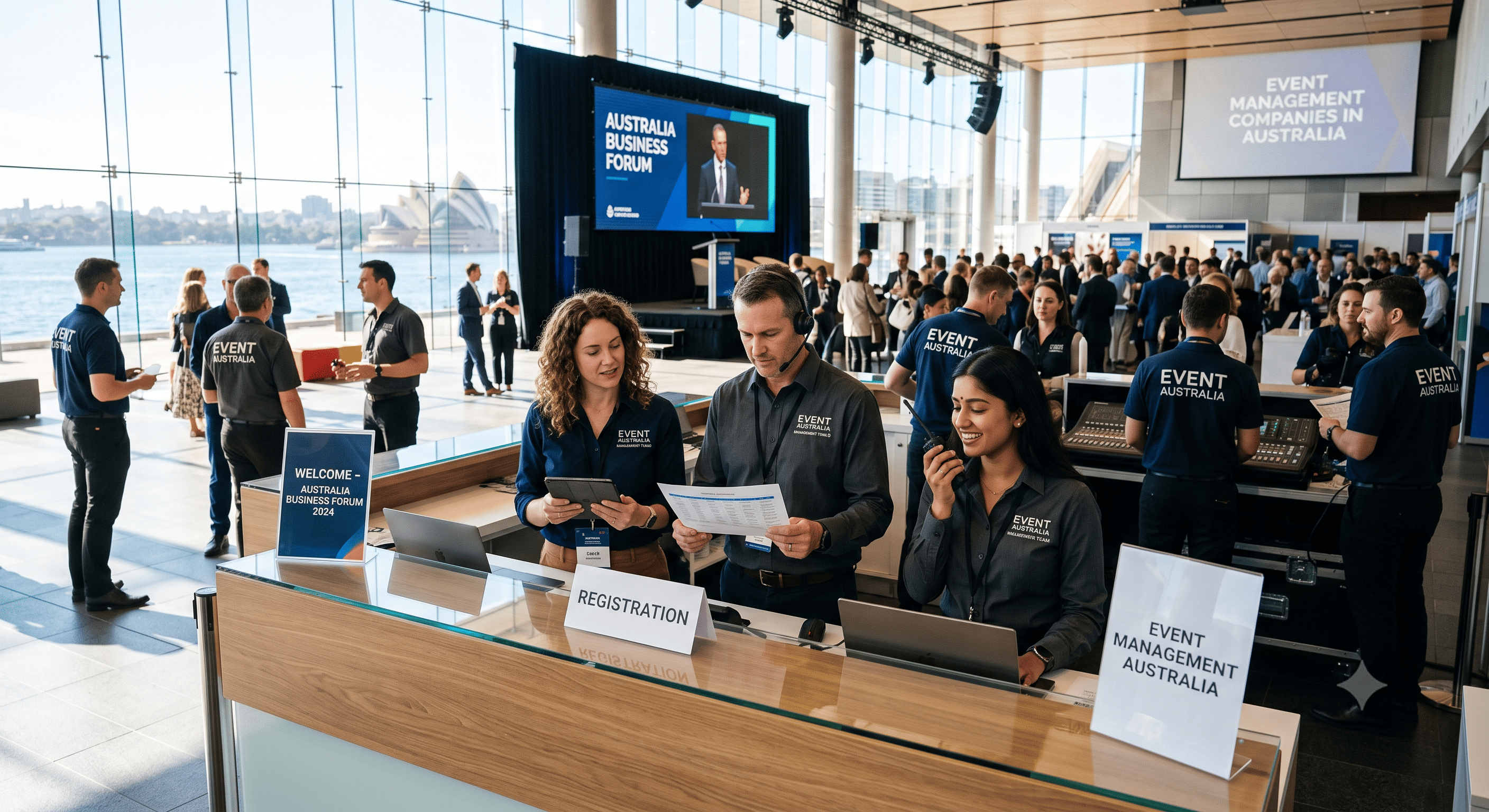
Planning a corporate conference, a product launch, or a large-scale festival takes more than a good idea. It takes a team that knows venues, suppliers, logistics, and budgets inside out. That’s why so many Australian businesses turn to a professional event management company rather than handling it all in-house.
This guide rounds up the best event management companies in Australia for 2026, drawn from client reviews on trusted platforms including Clutch and GoodFirms. If you’re after a national agency with global reach or a smaller specialist team, you’ll find a fit here.
Why Australian Businesses Hire an Event Management Company
Running an event internally sounds cheaper on paper. In practice, most teams underestimate the hours involved.
- Time saved: Sourcing venues and chasing suppliers alone can take weeks.
- Supplier relationships: Established event management companies already have preferred rates with venues, caterers, and AV providers.
- Risk reduction: Contracts, permits, and contingency planning are easy to get wrong without experience.
- Better outcomes: A team that runs events for a living will spot problems before they happen.
- Scalability: A good agency can staff up for a five-hundred-guest conference or scale down for a small board dinner, without you hiring in either direction.
- Honest feedback: An outside team will tell you if a venue, date, or format won’t work, rather than agreeing just to keep a project moving.
Australian event management companies also bring valuable knowledge of local regulations and venue requirements, from permits and liquor licensing to safety, accessibility and supplier compliance, which can trip up an inexperienced organiser fast.
Cost is usually the main hesitation, and it deserves a fair comparison. Most businesses aren’t weighing an agency fee against doing the work for free. They’re weighing it against staff hours pulled off other jobs, plus the cost of mistakes made without experience. An event management company often earns back part of its fee through supplier discounts alone, since established agencies negotiate rates that a single business can’t access on its own.
If you’ve typed “event mgmt companies” into Google at 11pm chasing last-minute help, you already know how crowded this space is. Quality varies a great deal between listings, which is exactly why checking a company’s track record matters more than checking price alone.
Here’s our list of standout event management company options, based on verified client feedback and years of operation in the Australian market.
1. On Purpose Events
Website: onpurposeevents.co
Founded in 2009, On Purpose Events tops this list for good reason. The Sydney-based team also runs satellite offices in Melbourne and Brisbane, and delivers events across Australia and the wider Asia-Pacific region, including Fiji, New Zealand, Singapore, Bali, Japan, and Thailand.
- Full-service conferences, incentive travel, product launches, and corporate events
- Works with major brands including Adobe, ANZ, ResMed, LinkedIn, Danone, and Temenos
- Delivered Microsoft’s Australian 50th anniversary celebration, connecting employees with the company’s global anniversary broadcast that reunited Bill Gates, Steve Ballmer, and Satya Nadella on stage together for the first time in over a decade
- Sustainability built into every event, not added as an afterthought
- Long-running association, government and education ties, including work for UNSW, RMIT, University of Sydney and various government and association programmes. Draws on global hotel partnerships with AccorHotels, IHG, and Marriott for venue and accommodation options
Clients often mention direct access to senior planners rather than being passed along to junior staff once a contract is signed. That matters when a three-day conference is only weeks away and quick decisions are needed.
Reporting goes further than a wrap-up email, too. Every programme closes with a post-event debrief covering attendance, engagement, sustainability outcomes, and commercial results such as leads generated or sales performance, giving stakeholders a clear answer on return on investment.
This cross-sector experience, spanning private companies and public institutions, gives the team a broader view of budget constraints and approval processes than agencies that only serve one sector.
2. FCM Meetings & Events
Website: fcmtravel.com
FCM Meetings & Events operates within the Flight Centre Travel Group, pairing event management with group travel booking. The team handles conferences, gala dinners, and product launches for corporate clients, supported by a self-serve venue finder tool.
The agency holds ATIA accreditation and works across both domestic and international events. Its link to Flight Centre’s travel network may suit businesses that want flights, accommodation, and event delivery handled by one provider.
3. Arinex
Website: arinexgroup.com
Arinex has operated as a professional conference organiser since 1973, with offices in Australia and New Zealand. The agency works mainly with associations and government bodies on conferences, incentives, and destination programmes.
Arinex holds membership with several international conference-organiser bodies and has worked with convention centres in Melbourne, Perth, and Sydney. Its client base leans more to association congresses than corporate product launches or brand activations.
4. Veritas
Website: veritas.com.au
Veritas has traded from Sydney since 1992, covering event management, brand activation, and AV and technical production for corporate clients. The agency offers these services under one roof rather than as separate specialisms.
Veritas has worked across the automotive and technology sectors on product launches and incentive travel. Businesses wanting AV and technical production handled alongside event planning, rather than outsourced separately, may find this combination convenient.
5. MCI Australia
Website: wearemci.com
MCI Australia is part of the global MCI Group, with offices in Sydney, Melbourne, and Brisbane. The agency covers association congresses, corporate incentive programmes, and destination management for both corporate and public-sector clients.
Sustainability reporting is included as standard, drawing on frameworks used across the wider MCI Group network. This may suit associations wanting sustainability credentials built into their congress or conference management.
6. Lateral Events
Website: lateralevents.com
Lateral Events has run from Sydney since 1996. Led by CEO Megan Peters, the agency now operates across Australia, New Zealand, Canada, the United Kingdom, and Singapore.
The team splits its work across three areas: large events for major corporations, corporate conference and exhibition management, and theatre or arena touring productions featuring well-known personalities. That range suits brands wanting one partner across very different event formats, rather than juggling separate suppliers for each.
7. Best Case Scenario
Website: bestcasescenario.com.au
True to its name, Best Case Scenario specialises in event planning and logistics for the corporate and technology sector. Founded in 2007 by Luli Adeyemo, the Sydney-based agency counts Microsoft and Broadcom among its long-running clients.
The business holds WeConnect International certification as a women-owned enterprise and sits on Microsoft’s supplier panel for event services in Australia. Work ranges from exhibitor stands and sponsorship activations at major technology conferences through to full-scale study tours and international delegate programmes.
8. GEMS Event Management
Website: gemsevents.com.au
Established in 1991, GEMS Event Management has spent more than three decades managing business and special events across Australia. The agency operates as a certified Professional Conference Organiser, working mainly with associations, government bodies, and not-for-profit clients rather than private corporates.
GEMS runs from a head office in Five Dock, Sydney, with a second regional office in Tweed Heads, and uses EventsAir software to manage registration, abstract submission, and sponsorship processes for conferences. That focus on association work makes GEMS a strong fit for membership bodies running an annual congress, rather than a business planning a one-off product launch.
9. OP Events
OP Events is a Sydney-based event agency delivering corporate, social and private events across Australia. Established in 2009, the team creates and manages experiences for more than 35,000 attendees each year, combining the capability to deliver at scale with responsive, personalised service.
From conferences, gala dinners and product launches to celebrations and team experiences, OP Events offers flexible support shaped around each brief. The agency has received national industry recognition, including being named a finalist in the Australian Event Awards and Australian Customer Service Excellence Awards, and has built a strong portfolio of long-standing and repeat corporate clients.
10. Extraordinary Events Pty Ltd
Website: extraordinaryevents.com.au
Based in Double Bay, Sydney, and operating since 1998, Extraordinary Events Pty Ltd is one of the longer-running names in the local events scene. Director Neil Santer built much of the agency’s process around a structured, phase-by-phase planning method developed over two decades in the industry.
That method now exists as a standalone online course for aspiring event planners, alongside the agency’s client-facing event delivery work. Smaller in size than some of the bigger names on this list, Extraordinary Events tends to suit clients who want closer, more hands-on attention throughout planning.
11. ID Events Australia
Website: ideventsaustralia.com
ID Events Australia has operated out of Sydney since 1973, giving it more than fifty years in destination management and incentive travel. The agency has delivered over 2,000 events, including logistics for Oprah Winfrey’s 2010 Ultimate Australian Adventure tour.
As a member of Meetings and Events Australia, the team focuses heavily on incentive programmes, conferences, and destination experiences for both local and international groups. Businesses bringing overseas delegates into Australia, or planning a multi-city incentive trip, are the clearest fit for this kind of destination-management expertise.
What to Consider When Selecting an Event Management Company in Australia
The right agency will depend on the nature of your event, your internal capabilities and the level of support required. When comparing potential partners, consider:
- Relevant experience: Look for demonstrated experience delivering events of a similar type, scale and complexity, not simply an impressive list of client logos.
- Service scope: Confirm whether the agency provides end-to-end management or selected services only. This may include strategy, creative development, venue sourcing, delegate management, travel, production, sponsorship, risk management, onsite delivery and post-event evaluation.
- Team structure: Understand who will manage your event, which specialists will be involved and how continuity will be maintained from the initial brief through to delivery.
- Budget transparency: Ask for a clearly defined scope and fee structure, together with an itemised event budget covering third-party costs such as venue, catering, production, staffing and travel. This makes it easier to understand what is included and compare proposals fairly.
- Technology capability: For conferences and complex events, consider the agency’s experience with registration platforms, event apps, onsite check-in, virtual or hybrid delivery, data management and reporting.
- Risk and governance: Confirm that the agency carries appropriate insurance and has thorough processes for supplier compliance, risk assessment, contingency planning, privacy and duty of care.
- Geographic reach: If your event involves multiple cities or international destinations, look for demonstrated delivery experience and trusted supplier networks in each location, not simply a stated ability to operate there.
- Sustainability: If environmental or social outcomes matter to your organisation, ask how these considerations will be incorporated into venue selection, catering, travel, production, procurement and measurement from the outset.
- Track record: Review relevant case studies, client testimonials and measurable outcomes. For high-value or complex projects, consider requesting a reference from a client with a comparable event.
Timing matters too. Major conferences, incentives and multi-day programmes are ideally planned six to twelve months in advance, particularly where venue availability, accommodation or group travel come into play. Smaller events may be delivered within shorter timeframes, but additional lead time generally provides greater choice, better planning conditions and more opportunity to create value.
Final Thoughts
Australia’s events industry is competitive, and that works in your favour as a buyer. Whether you need a full-service partner like On Purpose Events, whose case studies span everything from Microsoft’s 50th Birthday Celebration to national conferences for Danone, or a smaller specialist team, there’s a strong pool of experienced options to choose from in 2026.
A few warning signs are worth watching for during the pitch stage. Vague pricing, reluctance to share past client names, and a sales team that vanishes once the contract is signed are all reasons to keep looking elsewhere. The agencies on this list earned their place partly because verified client feedback backs up what they say about themselves.
Start with a clear brief: event type, guest count, budget range, and any must-have dates. Send that same brief to two or three agencies from this list, and compare not just price, but how well each team understands what you’re trying to achieve.
Once you’ve narrowed it down to a couple of options, ask each one for a reference client in a similar industry or event size. A short call with someone who has already worked with the agency tells you more in ten minutes than another round of proposals ever will.