


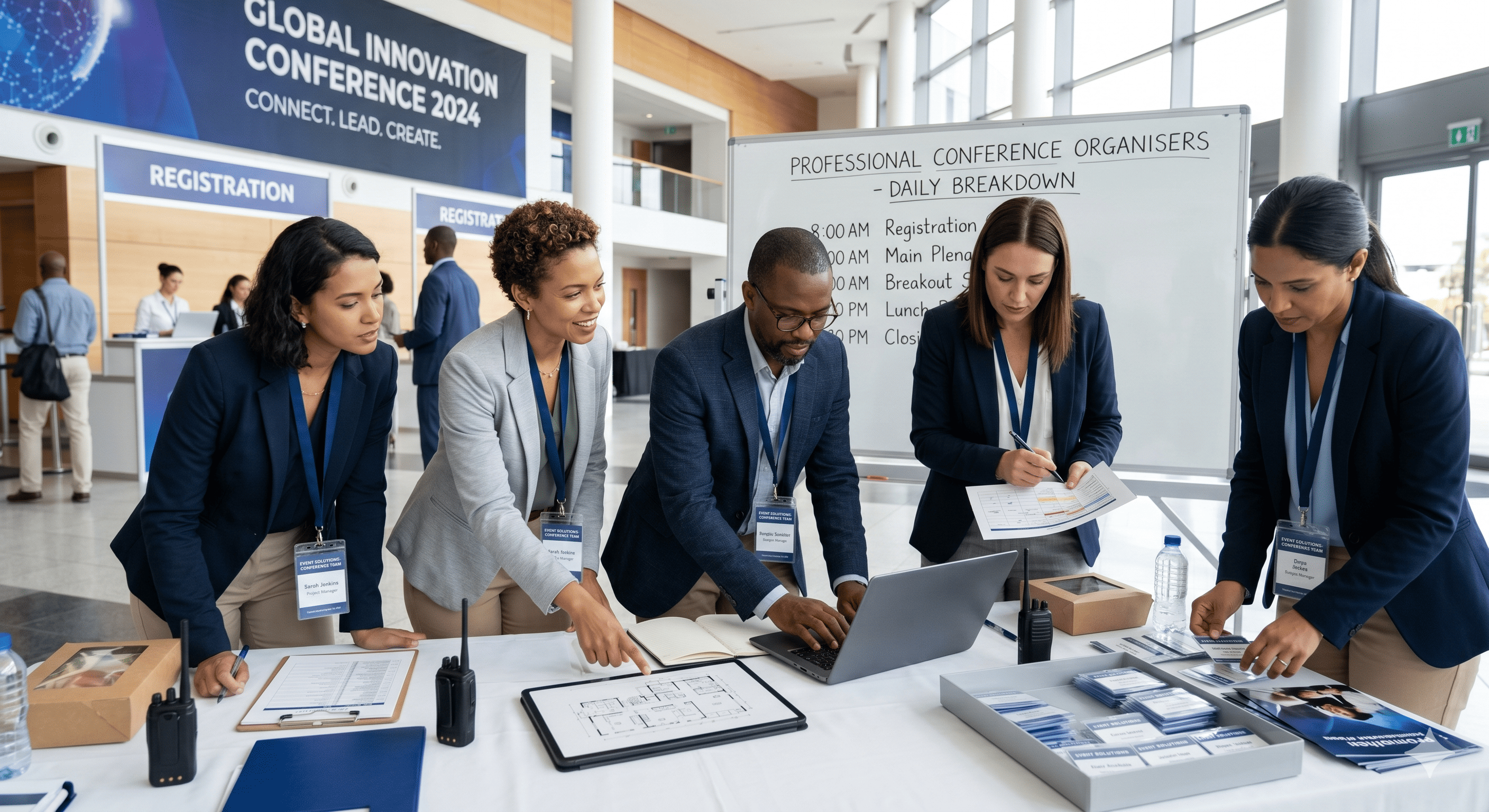
Professional Conference Organisers: What They Do and When to Hire One
Most organisations running a conference for the first time underestimate what the work involves. The agenda gets drafted, a venue gets shortlisted, and then the detail starts to surface. Speaker logistics. Delegate registration. Audio-visual production. Accommodation blocks. Catering across multiple sessions. Sponsorship management. Signage. Run sheets. Risk plans. Post-event reporting.
This is the work a Professional Conference Organiser handles. The role exists because conferences sit in a category of events where the operational detail compounds quickly, and a small mistake in week three of planning can become a significant problem on day one of delivery. Choosing the right conference organisers comes down to scale, experience, and the supplier network they bring to the table.
This guide explains what PCOs deliver, how they differ from adjacent roles, and when hiring one is the right commercial decision for your organisation.
What a Professional Conference Organiser Actually Delivers
A PCO manages the end-to-end delivery of a conference, from initial scoping through to post-event reporting. The scope is broader than most clients expect when they first engage one.
On the strategic side, a PCO works with the client to define objectives, set the budget framework, and shape the programme structure. This includes audience segmentation, content architecture, sponsor strategy, and the delegate journey across the full programme. The work happens months before any logistics begin.
On the operational side, the PCO handles venue selection and contracting, supplier management across audio-visual, catering, accommodation and transport, delegate registration and communications, speaker management, sponsor and exhibitor coordination, on-site delivery, and post-event reporting.
The reporting layer is often what separates a strong PCO from a competent one. A useful debrief covers attendance and engagement metrics, session-level feedback, sponsor satisfaction, supplier performance, financial reconciliation, and recommendations for the next programme. This is the document the client takes to senior stakeholders to evidence the value of the conference.
PCO vs Conference Planner vs Event Manager: Where the Lines Sit
The terms get used interchangeably, which causes confusion at the briefing stage. The distinctions matter because they shape what you can expect from the engagement.
A Professional Conference Organiser specialises in conference and meeting programmes. The expertise sits in managing complex multi-stream events with delegate volumes from a few hundred to several thousand, multiple stakeholder groups, and reporting requirements that satisfy senior leadership.
A conference planner often refers to a similar role but may sit closer to the logistics end of the spectrum. The title is used more loosely and can mean anything from a senior PCO to a coordinator handling the run sheet.
An event manager covers a broader category. The role manages conferences alongside product launches, incentive travel, gala dinners, awards nights, and brand activations. A senior event manager working on conferences will deliver similar outcomes to a PCO, particularly in agencies that handle both.
For most clients, the practical question is not which title to hire but which capability the brief actually needs. A conference for two thousand delegates with multiple streams and twenty sponsors needs PCO-level capability regardless of the title on the contract.
When Hiring a PCO Makes Commercial Sense
The decision to bring in external support comes down to scope, internal capacity, and risk tolerance. Several scenarios point clearly toward hiring a PCO.
When the conference is large or complex enough that a single coordinator cannot hold the full picture, external support pays back quickly. The threshold sits somewhere around one hundred and fifty delegates, multiple concurrent streams, or a programme that runs across more than two days.
When the internal team has other priorities that cannot wait, a PCO removes the planning load without removing the strategic input. The client team stays involved in the decisions that matter and steps back from the operational detail that consumes time without producing differentiated value.
When the conference carries reputational weight – a flagship customer event, a leadership summit, a sector congress – the cost of operational error is high enough that specialist delivery becomes a risk management decision rather than a budget question.
When the client team is running their first conference at scale, a PCO provides the institutional knowledge that internal teams build over multiple programmes. The first conference is rarely the right one to learn on.
When ESG or sustainability reporting is part of the brief, PCOs with sustainability capability handle the measurement and reporting in ways internal teams typically cannot. This is increasingly part of corporate event briefs in Australia, particularly for organisations with public ESG commitments.
When Internal Delivery Is the Right Call
External support is not always the right answer. Some scenarios point toward internal delivery instead.
Smaller programmes with fewer than one hundred and fifty delegates, single-stream content, and an internal team with conference experience can often be delivered well in-house. The cost of external support may exceed the operational lift saved.
Programmes that require deep internal knowledge – a highly technical sales conference, a sensitive leadership offsite, a strategy session with confidential content – sometimes work better with internal delivery for confidentiality reasons, with external support brought in only for specific elements like venue sourcing or production.
Recurring programmes where the internal team has already built the operational machinery often run efficiently in-house, with PCO support reserved for years when the format changes significantly or scale increases.
The honest test is whether the internal team has the capacity, capability, and risk tolerance to deliver the programme to the standard senior stakeholders expect. If the answer is uncertain, the conversation with a PCO is worth having.
How to Choose the Right Professional Conference Organiser
Choosing a PCO is more like hiring a senior team member than buying a service. The fit matters as much as the capability list.
Track record is the first filter. Ask for case studies of conferences similar in scale, audience, and complexity to your brief. Look for evidence the PCO has delivered for organisations with comparable governance, reporting, and stakeholder requirements. A PCO that has run programmes for ASX-listed companies, government departments, or large professional services firms understands what those environments demand. For New South Wales-based organisations, working with professional conference organisers in Sydney who know the local venue landscape, supplier network, and seasonal demand patterns adds another practical layer of value to that track record.
Senior team access is the second filter. The senior specialist who pitches for the work should be the senior specialist who delivers it. Ask directly who will run your programme day to day, and what proportion of their time will sit on your account. Junior account management on a complex conference produces predictable problems.
Supplier relationships matter more than they appear to. A PCO with established relationships across venues, audio-visual production, catering and accommodation can produce better outcomes at the same budget than one starting from scratch. Ask about preferred supplier networks and how they are used.
Sustainability capability is now a practical filter for many Australian briefs. PCOs that have integrated sustainability measurement into their delivery, rather than offering it as an add-on, produce better outcomes at lower friction. Industry certifications and ongoing reporting partnerships are useful indicators.
Cultural fit is the filter clients underweight. The PCO will work alongside your team for months. The relationship needs to be one that handles pressure well, surfaces problems early, and produces honest conversations about scope and trade-offs.
What a Good PCO Brief Looks Like
The quality of the brief shapes the quality of the proposal you get back. A useful PCO brief covers several elements.
Conference objective and audience: what the programme is meant to achieve, who is attending, and what success looks like for senior stakeholders. This is the section most briefs underplay.
Scope and scale: delegate numbers, programme length, format, location preferences, and any fixed elements. If dates and venues are already locked, say so. If they are flexible, say that too.
Budget framework: even an indicative range is more useful than no budget. PCOs cannot produce realistic proposals without knowing the order of magnitude.
Reporting requirements: what the client team needs to take to senior stakeholders, including any ESG, financial, or commercial measures.
Decision timeline: when the appointment will be made and when the work needs to begin. PCO availability for major programmes is often constrained twelve months out.
A brief that covers these elements produces sharper proposals and a faster path to the right partner.
Pricing Models and What Drives Them
PCO pricing varies depending on engagement model and programme complexity. The common structures include a project fee covering full delivery scope, a fee plus expenses model, a percentage of overall programme spend, or a hybrid covering retained strategic input plus delivery fees.
The drivers of cost are programme scale, complexity of stakeholder management, level of senior team input required, and the operational footprint on the day. A two-day single-stream conference for three hundred delegates sits in a different price band to a four-day multi-stream congress for two thousand.
Transparency at the proposal stage is a useful test of how the PCO will work through the engagement. Itemised proposals with clear assumptions are easier to manage than fixed quotes that hide the underlying logic.
Working Well With Your PCO
The clients who get the most from a PCO engagement treat it as a partnership rather than a vendor relationship. A few practical habits make the difference.
Single point of contact on the client side reduces friction and produces clearer decisions. The PCO needs someone who can answer questions, escalate when needed, and make calls within an agreed scope without going to committee.
Decision discipline matters more than people expect. Conference timelines are unforgiving, and decisions deferred by two weeks at month three often produce visible compromises at delivery. A clear governance structure on the client side prevents this.
Honest scope conversations early prevent scope creep later. If the brief evolves, address it openly rather than absorbing it. Most PCOs will accommodate reasonable changes if they are surfaced in time.
Getting Started
If a conference is in your 2026 plan and you want to talk through what hiring a PCO might look like for your programme, get in touch for an obligation-free conversation. Our meetings and conference planning service covers the full delivery scope from initial scoping through to post-event reporting.