


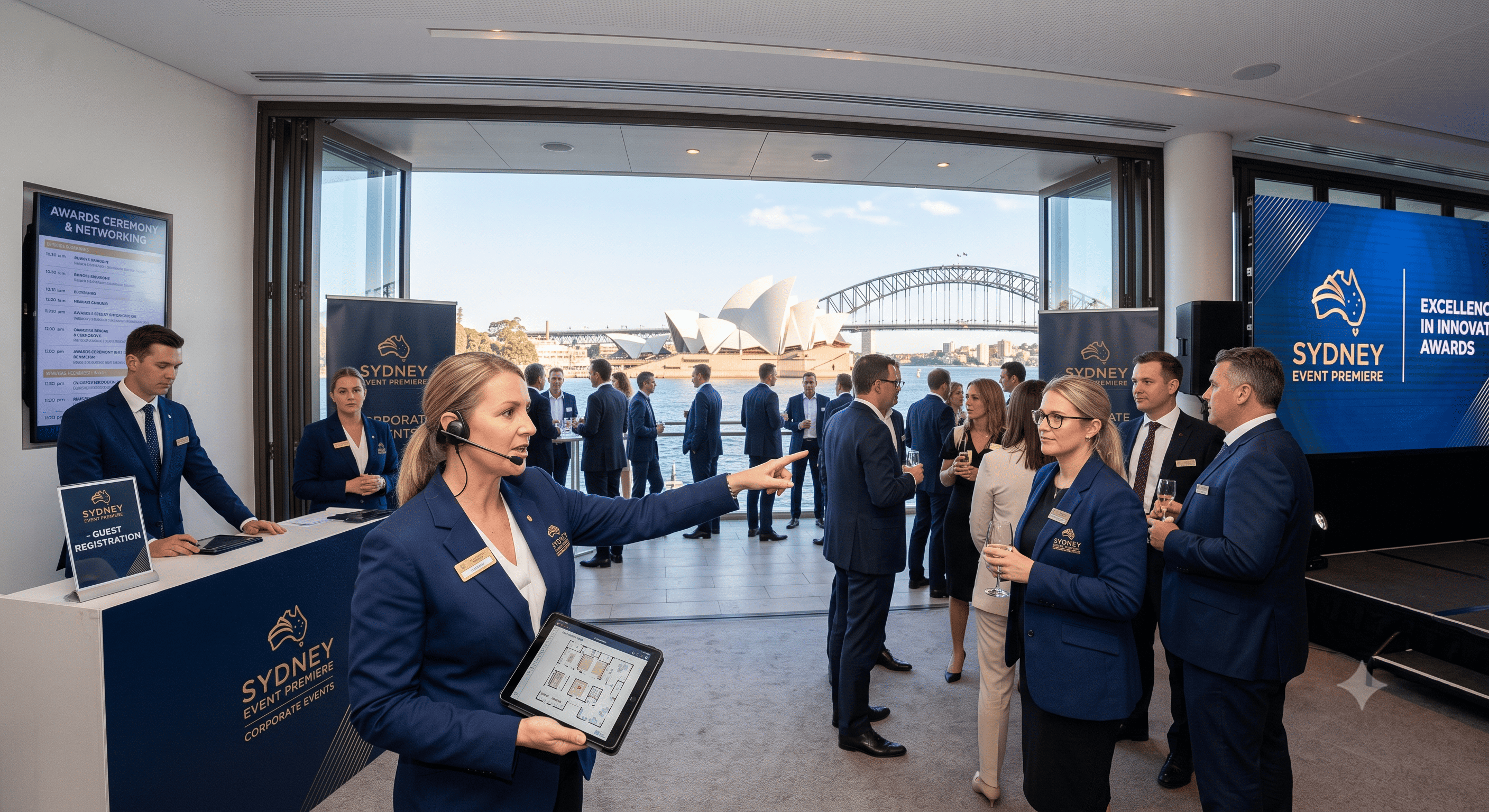
Booking a venue is the easy part. Managing catering, AV, run sheets, staffing, and a nervous executive who wants everything perfect is where most in-house teams start to struggle. That’s exactly the gap corporate event management fills.
If you’ve never worked with a corporate event management company before, the process can feel like a bit of a black box. You send a brief, and somehow a fully staffed conference appears weeks later. This guide breaks down exactly how corporate event management works in Sydney, what each stage costs, and what you should expect from a good provider.
If you’re comparing corporate events Sydney options for the first time, or you’ve worked with an event management company Sydney business before and just want a refresher, this covers the full picture.
Sydney’s corporate events market is busy year-round, from finance sector conferences in the CBD to product launches along the harbour. That demand means plenty of choice, but it also means the good providers get booked out early. Knowing how the process works helps you move quickly once you’ve found the right one.
What Is Corporate Event Management?
Corporate event management is the process of planning, organising, and running business events on a company’s behalf. That covers conferences, product launches, staff functions, award nights, and client entertaining.
A corporate event management company usually handles everything between the initial idea and the final wrap-up report. Some businesses only need help with one part, such as venue sourcing. Others hand over the whole project and step back until the day itself. This breakdown of what an event management company does covers the full scope in more detail.
The line between “event planning” and “event management” often blurs in casual conversation. Planning covers the ideas and the logistics on paper. Management covers delivery. It’s the difference between having a plan and having someone make sure that plan actually happens, on budget and on time.
Corporate event management typically covers events such as:
- Conferences and multi-day summits
- Product launches and brand activations
- Staff milestones, awards nights, and end-of-year functions
- Client hospitality and networking events
- Team offsites and training days
Some of these need a full production team. Others just need one experienced coordinator keeping everything on track. A good provider will tell you which one your event actually needs, rather than upselling every project to the same scale.
How Corporate Event Management Works in Sydney
Every reliable event management process follows a similar shape, even if the exact steps vary slightly by provider. For a closer look at how this plays out locally, this guide to event management in Sydney covers the destination-specific detail.
1. Brief and Proposal
It starts with a brief. You outline your goals, guest numbers, budget range, and preferred dates. A solid corporate event proposal follows within a few days, setting out scope, indicative costs, and a rough timeline.
This step matters more than people expect. A vague brief usually leads to a vague proposal, and a vague proposal makes everything after it harder to manage.
Most agencies will ask for a few basics upfront: rough guest numbers, preferred dates or a date range, must-have inclusions, and a budget ceiling. The more specific you can be here, the faster and more accurate the proposal will be.
2. Venue and Budget
Once you approve the proposal, the team starts sourcing corporate event venues Sydney has to offer that match your brief. Budget gets locked in properly at this stage too, not just estimated on the back of an envelope.
This is also the stage where costs firm up properly. A provisional figure from the proposal becomes a confirmed budget once real venue and catering quotes come back, rather than an estimate based on guesswork.
3. Planning and Coordination
This is where most of the actual work happens, and where clients see the least of it. Suppliers get booked. Run sheets get built. A corporate event checklist keeps every task tracked against a corporate event planning timeline, so nothing slips through as the date gets closer.
- Catering, AV, and staging suppliers are confirmed and briefed
- Staff rosters and on-the-day roles are assigned
- Contingency plans are built for weather, no-shows, or last-minute changes
4. Event Day
On the day, the management team handles setup, staffing, timing, and problem-solving. Good corporate event management services make this stage look almost boring, in the best possible way. Nothing breaks. Nothing runs late. Guests rarely notice the hundred small decisions being made around them.
Behind the scenes, someone is usually running a live schedule down to the minute, adjusting for a late speaker or a delayed delivery without anyone in the room noticing. That’s the real value of hiring the process out rather than running it internally.
5. Wrap-Up and Review
After the event, a proper wrap-up covers attendance, feedback, and what worked well. This step gets skipped by weaker providers. It’s also the one that makes your next event much easier to plan, since you’re not starting from zero again.
What to Expect From a Corporate Event Management Company
A few things separate a genuinely reliable provider from a shaky one. Look for these before you sign anything.
- A clear proposal. You should receive a written scope of work, not just a verbal quote over the phone.
- Direct access to a senior planner, rather than a junior account manager handling everything after the pitch.
- Transparent budget tracking. A decent corporate event budget breakdown covers venue, catering, staffing, and production as separate line items.
- One point of contact. A single coordinator manages suppliers, rather than five different people emailing you separately.
- A realistic timeline. Good corporate event planning services will tell you honestly if your date is too tight, rather than agreeing to everything upfront.
If a provider can’t answer these points clearly early on, that’s worth noticing before you commit any budget.
Choosing the Right Corporate Event Planner in Sydney
Sydney has plenty of corporate event planners Sydney businesses can choose from, ranging from small boutique studios to large national agencies. A few things separate the strong ones from the average ones, and this guide to choosing an event management company expands on all of them.
Check Their Experience in Your Sector
A corporate meeting planner used to running finance sector conferences may not be the right fit for a creative product launch, and the reverse is just as true. Ask what industries a shortlisted agency actually works in most.
Ask About Their Local Supplier Relationships
Established corporate event companies Sydney wide already have venue and supplier relationships built up over years. That usually translates into better rates and faster turnaround than a newer agency starting from scratch.
Ask for References, Not Just Reviews
Star ratings only tell part of the story. Ask any corporate event planner Sydney businesses are considering for a reference client in a similar industry, then actually call them.
Pay Attention to Their Response Time
How quickly an agency replies during the pitch process is a fair preview of how they’ll communicate once you’ve signed. If getting a straight answer takes days before you’re even a client, that pattern rarely improves afterwards.
How to Plan a Corporate Event on a Tight Deadline
Not every business has months of lead time. Sometimes the brief lands on a Monday and the event is six weeks out. A few steps make this smoother:
- Nail down guest numbers and budget range before the first call, not during it
- Be upfront about hard deadlines. Suppliers can often move faster than expected, for the right event and the right notice
- Ask what event management services Sydney providers can realistically strip back if the timeline is the real constraint, not the budget
Speed usually costs more, not less. A compressed timeline often means paying a premium for supplier availability, so it’s worth being clear about that trade-off from the start.
Corporate Event Management Costs in Sydney
Costs vary enormously depending on scale. A hundred-person conference costs a fraction of a five-hundred-person gala with entertainment and full staging. This breakdown of corporate event costs across Australia goes into more detail than a single table can.
The table below gives a rough sense of scale. Treat it as a starting point for conversation, not a quote.
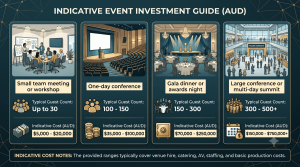
These ranges cover venue hire, catering, AV, staffing, and basic production. Anything more elaborate, such as custom staging, international speakers, or hybrid livestreaming, pushes the figure higher.
Note event costs vary significantly according to location, duration, venue, production requirements, catering, travel, speaker costs and the level of agency support required.
Ask for an itemised quote broken down by venue, catering, staffing, and production, rather than a single lump sum. That makes it far easier to compare corporate event management Sydney providers against each other, and to see exactly where the budget is actually going.
Most established agencies offer a free initial consultation before quoting properly. Use that conversation to ask hard questions about past projects similar to yours in size and industry.
Management fees themselves are usually structured one of two ways: a flat project fee, or a percentage of total event spend. Neither is automatically better. A flat fee suits a well-defined event, while a percentage model can suit a project where the scope might grow. Ask which model a provider uses before you compare quotes side by side, since the numbers won’t mean much otherwise.
Common Mistakes That Delay Corporate Events
A few patterns show up again and again, even with experienced teams running the event internally.
- Locking in a date before checking venue availability. Popular Sydney venues book out fast, especially for end-of-financial-year functions.
- Underestimating AV and staging costs. These often cost more than catering on a per-guest basis, particularly for hybrid or livestreamed events.
- Skipping a proper contingency plan. Weather, last-minute cancellations, and supplier delays are common enough that a backup plan should exist before the day, not get improvised on it.
- Treating the wrap-up as optional. Skipping the review stage means repeating the same avoidable mistakes at the next event.
None of these are difficult to avoid. They just need to be raised early, ideally during the brief and proposal stage rather than once planning is already underway.
Final Thoughts
Corporate event management isn’t complicated once you understand the shape of it: brief, proposal, planning, delivery, review. What separates a good provider from an average one is how much of that process you actually have to think about yourself.
If you’re comparing Sydney corporate events providers for an upcoming conference or function, start with a clear brief and ask to see the proposal format before you commit. That alone filters out a surprising number of weaker options. Get two or three quotes, compare them properly, and trust the provider that asks the most questions about your goals rather than the one that promises the most extras.
If you’re building a shortlist, we’d love to be on it. Our Sydney-based team has been running corporate conferences, product launches, and incentive travel since 2009, and we consistently deliver on the senior-access point raised earlier in this guide, rather than handing clients off after the pitch.
Sustainability is also built into how we work, not offered as a paid extra. If reducing your event’s environmental footprint matters to your organisation, that’s worth raising during the brief stage covered earlier in this guide, since it’s far easier to build in from the start than add on later.