


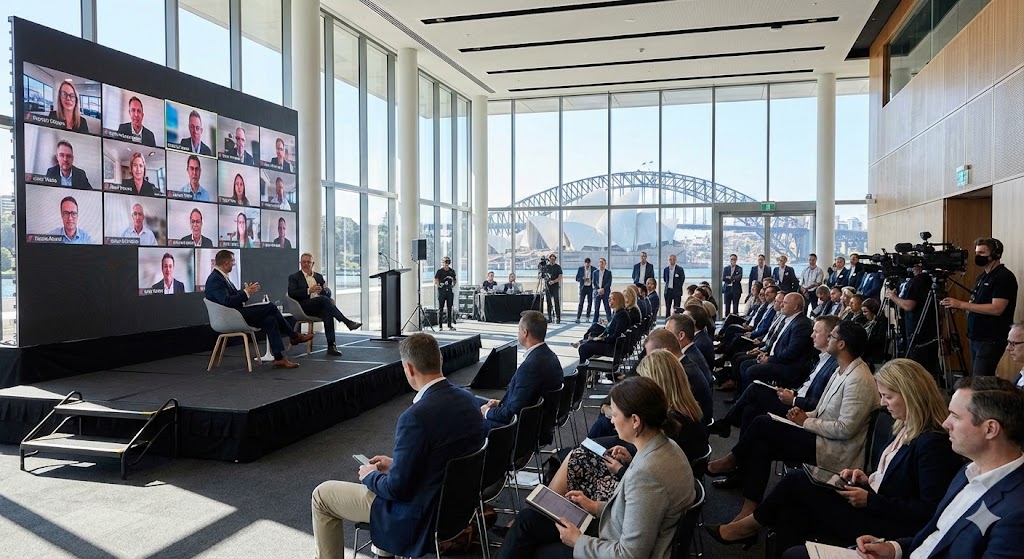
Strategic Context: Hybrid Events in Corporate Portfolio Planning
Sydney’s position as Australia’s leading business events destination creates both opportunity and pressure. Corporate event programmes are increasingly expected to demonstrate strategic value, not just operational success. CFOs are scrutinising spend more closely, and Boards want clear evidence that resources are being allocated effectively.
The reality is nuanced. Research shows that 95.4% of corporate decision-makers still view in-person events as important, while organisations simultaneously face tighter budgets, broader stakeholder audiences and higher expectations around measurement. Hybrid event delivery resolves this tension by combining the relationship-building power of face-to-face interaction with the reach, accessibility and data visibility of virtual engagement.
At On Purpose Events, we specialise in corporate hybrid conferences that deliver measurable business outcomes across both physical and virtual environments. Our approach combines high-quality production with strategic planning frameworks that link event delivery directly to corporate objectives, stakeholder engagement goals and Board-level KPIs.
For organisations planning 2026 event programmes, the question is no longer whether hybrid delivery has value, it’s how to use it deliberately to create competitive advantage and measurable return.
Executive Framework: Measuring Corporate Hybrid Event ROI
For CFOs and senior leaders evaluating event investment, hybrid delivery changes what can be measured, and how events are valued. Rather than being treated as cost centres, hybrid events can be assessed as strategic assets with clear links to business performance.
With 68% of event marketers citing internal budget pressure as their primary challenge, meaningful ROI measurement is no longer optional. Hybrid events provide the data and visibility needed to connect investment to outcomes that matter at executive and Board level.
Strategic ROI Framework for Corporate Hybrid Events:
- Wider Reach, Smarter Spend: A Sydney-based corporate conference designed for 300–500 in-person executives can engage thousands more stakeholders through hybrid delivery. The result is broader reach and stronger relationships, with a significantly lower cost per engagement.
- Making Better Use of Executive Time: Senior leadership time is valuable. Hybrid formats allow C-suite leaders to participate meaningfully without the need for multi-day travel, enabling involvement that would be unrealistic in a single-format event.
- Accelerating Business Conversations: Hybrid events make it easier to track commercial outcomes, from new business conversations and partnerships to deal progression. Modern platforms connect event participation directly to business development and revenue activity.
- Extending the Value of Learning: On-demand access allows learning to continue well beyond the live event. Measuring retention, certification and capability development across both audiences helps maximise the return on training investment.
- Clearer Insight into What Resonates: Engagement data shows which sessions, topics and formats connect with different stakeholder groups. These insights support smarter decisions around content, positioning and future strategy.
- Understanding Brand Impact: Hybrid delivery allows organisations to track shifts in sentiment, visibility and positioning across wider audiences, offering a clearer picture of brand impact than in-room events alone.
- More Efficient Cost Structures: When total programme costs (including venue, catering, travel, accommodation and production) are measured against total engagement, hybrid formats consistently deliver stronger efficiency, often improving cost per engagement by 40–60%.
- Supporting Sustainability Goals: Reduced travel directly contributes to lower Scope 3 emissions. Hybrid delivery supports ESG commitments while also reducing carbon-related business risk.
Corporate Hybrid Event Design: Stakeholder-Centric Architecture
Effective corporate hybrid events are deliberately designed around different stakeholder needs, while still delivering a consistent brand experience and clear business outcomes.
- Executive Participation, Without the Travel Burden: Senior leadership time is limited. Hybrid formats allow executives to contribute meaningfully, whether through keynotes, panels or priority sessions, but without the need for full programme attendance or extended travel.
- Premium Experiences for Key Clients: High-value clients expect experiences worth travelling for. In-person elements should focus on meaningful connection, exclusive access and relationship-building, while virtual audiences receive high-quality content and genuine opportunities to engage.
- Fair Access to Employee Learning and Development: Hybrid delivery ensures employees across regions have access to the same content and experience as headquarters teams. This supports talent development, engagement and retention across the organisation.
- Stronger Partner Engagement: Hybrid formats enable partners to participate regardless of location, strengthening relationships while making better use of time and engagement budgets.
- More Accessible Investor Communication: Investors and analysts can access critical updates and announcements without the friction of travel, increasing participation and improving the effectiveness of stakeholder communication.
- Enterprise-Grade Technology and Reliability: Corporate hybrid events require dependable infrastructure including professional broadcast equipment, backup connectivity, experienced production teams and platforms that meet security and data governance standards.
- Production Quality That Reflects Your Brand: For virtual attendees, production quality shapes perception. High standards in lighting, audio, visuals and presentation signal professionalism, credibility and respect for stakeholder experience.
Hybrid Event Production: Lessons from Sydney’s Leading Venues
Sydney’s leading venues have evolved rapidly to support hybrid delivery, offering production capabilities comparable to professional broadcast studios. Venues such as ICC Sydney and other purpose-built spaces now support sophisticated hybrid formats.
When selecting venues for hybrid events in Sydney, evaluate these critical factors:
- Technical Infrastructure: High-capacity internet, professional AV equipment, streaming capabilities, and backup systems ensure reliability.
- Flexible Spaces: Rooms that can be configured for both in-person audiences and broadcast production, with appropriate lighting, acoustics, and camera positions.
- Support Staff: Experienced technical teams who understand hybrid event requirements and can troubleshoot issues quickly.
- Hybrid-Ready Amenities: From LED walls displaying virtual attendee questions to dedicated virtual networking lounges, purpose-built hybrid spaces enhance both in-person and online experiences.
- Accessibility Features: Ensure venues support closed captioning, sign language interpretation, and other accessibility requirements for diverse audiences.
Maximising Virtual Attendee Engagement
Virtual audiences require intentional engagement strategies to maintain attention and participation.
Pre-Event Engagement: Begin engaging virtual attendees before the event starts. Send personalised agendas, facilitate pre-event networking, and build anticipation through content teasers and speaker introductions.
Personalised Experiences: Leverage data to create personalised agendas recommending sessions based on attendee role, industry, or stated interests. Personalisation signals that you value each participant’s unique needs.
Gamification: Incorporate game mechanics with points for session attendance, badges for networking, leaderboards for participation, designed to motivate engagement through friendly competition.
Virtual Lounges: Create dedicated virtual spaces for networking, discussion, and informal connection. These digital watercooler moments replicate the hallway conversations that make in-person events valuable.
On-Demand Content: Recognise that virtual attendees may span multiple time zones. Providing on-demand access to sessions expands accessibility whilst allowing attendees to engage when it suits their schedules.
Interactive Features: Use polls, quizzes, chat discussions, and Q&A actively throughout sessions. Virtual attendees should have multiple opportunities to participate in every session.
Recognition and Visibility: Acknowledge virtual attendee participation – reading their questions aloud, responding to chat comments, featuring their contributions. Visibility reinforces that virtual attendance matters.
Pricing Strategies for Hybrid Events
Hybrid events complicate traditional pricing models. Should virtual tickets cost the same as in-person? How do you balance accessibility with revenue requirements?
- Tiered Pricing: Offer different price points for in-person and virtual attendance, reflecting the different value propositions and cost structures. In-person typically commands premium pricing due to venue costs, catering, and enhanced networking.
- Value-Added Virtual: Rather than positioning virtual as “discount” attendance, frame it as a distinct value proposition – global accessibility, on-demand content, flexible scheduling, reduced travel cost and carbon footprint.
- Hybrid Packages: Offer packages that combine in-person and virtual elements, attend keynotes in-person but access breakout sessions on-demand, or vice versa.
- Sponsorship Innovation: Create sponsorship packages that provide value across both in-person and virtual audiences, like branded virtual lounges, sponsored on-demand content, or integrated digital/physical activations.
- Free Virtual Access: For certain event types, particularly those with strong brand-building or community-development objectives, offering free virtual access maximises reach whilst maintaining in-person ticket revenue.
Creating Memorable In-Person Experiences
Hybrid events expand reach, but in-person experiences remain critical. With 77% of people trusting brands more following face-to-face interactions at live events, the physical component of hybrid events deserves careful attention.
- Instagram-Worthy Moments: Create visually stunning installations, photo opportunities, and branded experiences that attendees want to share on social media. User-generated content extends event reach organically.
- Sensory Engagement: Leverage elements unavailable to virtual attendees like textures, scents, tastes, and spatial experiences that make in-person attendance distinctly valuable.
- Exclusive Access: Provide in-person attendees with unique opportunities – VIP networking sessions, speaker meet-and-greets, or behind-the-scenes experiences that justify premium pricing.
- Quality Over Quantity: With hybrid options reducing pressure to accommodate everyone in-person, you can prioritise quality experiences for those who do attend physically through smaller group sizes, more intimate settings and enhanced catering.
- Hybrid-Integrated Moments: Create moments where in-person and virtual attendees interact directly through joint breakout discussions, shared activities, or collaborative exercises that bridge the physical-digital divide.
At On Purpose Events, we design hybrid conferences where both attendance modes feel intentional, valuable and considered.
Technology Platforms for Hybrid Success
Hybrid event technology has matured significantly, with platforms offering increasingly advanced capabilities. Selecting the right technology stack is key for hybrid event success.
- Comprehensive Event Management Platforms: Solutions like Cvent provide end-to-end capabilities across registration, attendee management, mobile apps, virtual streaming, networking tools, and analytics, in integrated systems.
- Broadcast-Quality Streaming: Professional streaming platforms ensure reliable, high-quality video delivery to virtual attendees worldwide. Look for platforms offering adaptive bitrate streaming, multiple camera angles, and interactive features.
- Networking Facilitation: AI-powered matchmaking tools connect attendees with relevant contacts based on industry, interests, and objectives. These algorithms work equally well for in-person and virtual networking.
- Engagement Tools: Platforms offering live polling, Q&A, chat, virtual hand-raising, and reaction emojis keep both in-person and virtual audiences actively participating.
- Analytics Dashboards: Comprehensive reporting that tracks attendance, engagement, networking activity, and content consumption across both in-person and virtual attendees.
- Accessibility Features: Closed captioning, language translation, screen reader compatibility, and sign language interpretation ensure events are accessible to diverse audiences.
Hybrid Event Production Best Practices
Successful hybrid event production requires meticulous planning and execution. These best practices, refined through Sydney’s leading events, ensure smooth delivery:
- Dedicated Production Team: Assign separate teams to in-person experience and virtual production. Trying to serve both simultaneously often results in neither receiving adequate attention.
- Thorough Testing: Test every technical element multiple times before going live. Bandwidth, audio quality, camera angles, lighting, platform functionality. Test it all, then test again.
- Backup Systems: Have redundant internet connections, backup streaming equipment, and contingency plans for every conceivable technical failure.
- Clear Communication: Ensure speakers understand hybrid format requirements, including where to look for cameras, how to engage virtual audiences, when to pause for Q&A.
- Real-Time Monitoring: Monitor the virtual attendee experience throughout the event. Technical issues, audio problems, or engagement drops require immediate response.
- Professional Production Value: Invest in professional-grade equipment and operators. The difference between amateur and professional production dramatically impacts virtual attendee experience and event brand perception.
Measuring Hybrid Event Success
Beyond traditional ROI metrics, hybrid events enable deeper insights into event effectiveness through:
- Comparative Analysis: Compare in-person and virtual attendee behaviour, engagement, and satisfaction. These insights inform future hybrid strategy and resource allocation.
- Geographic Reach: Track where virtual attendees join from, revealing geographic markets you’re successfully reaching and potential growth opportunities.
- Engagement Timeline: Analyse when attendees join, how long they stay, and when they disengage. These patterns reveal optimal session timing and pacing.
- Content Performance: Identify which sessions drove highest attendance and engagement across both formats. Popular content can be repurposed for marketing, thought leadership, or future event planning.
- Networking Effectiveness: Track connections made, conversations initiated, and follow-up actions taken. Strong networking outcomes justify continued investment in networking features and facilitation.
- Technology Adoption: Monitor which platform features attendees use and which they ignore. This data guides future technology investment and attendee training.
On Purpose Events delivers comprehensive post-event reporting covering performance, insights and sustainability outcomes, enabling data-driven decisions for future events.
Business Case: Strategic Value of Hybrid Capabilities
For Board and C-suite leaders, hybrid events are not about efficiency alone. They are about protecting brand reputation, engaging stakeholders meaningfully and building organisational resilience through smarter ways of bringing people together.
Smarter Investment, Greater Reach: Hybrid delivery allows organisations to extend the reach of their events without proportionally increasing spend. While production costs can be higher than single-format events, the ability to engage more stakeholders drives a significantly lower cost per engagement and stronger overall returns.
Access Without Borders: Hybrid formats remove geographic limitations. Teams can engage stakeholders across Asia, Europe and North America at the same time, without the cost, complexity or carbon impact of global travel.
Equitable Access to Development: For distributed and hybrid workforces, hybrid events create fairer access to learning, leadership and connection, regardless of location. This supports engagement, retention and consistency across markets.
Built-In Resilience: Established hybrid capability protects continuity. Whether facing travel disruption, health risks or climate events, organisations can maintain momentum and stakeholder connection without relying solely on physical attendance.
Credible Sustainability Leadership: Reducing business travel is one of the most tangible ways organisations can lower emissions. Hybrid delivery demonstrates a genuine commitment to sustainability while aligning with ESG goals and stakeholder expectations.
Deeper Insight, Better Decisions: Hybrid platforms provide richer engagement data — revealing what resonates, where attention sits, and how stakeholders interact. This insight supports sharper decision-making than traditional in-room events alone.
Stronger Partner Engagement: Hybrid formats make it easier for partners to participate meaningfully without heavy travel investment. This strengthens relationships while respecting partner budgets and capacity.
More Efficient Investor Communication: Hybrid delivery enables broader reach for updates, announcements and briefings, improving accessibility for investors while reducing the cost and complexity of traditional investor relations programs.
Strategic Hybrid Evolution: Corporate Event Capabilities Beyond 2026
For corporate planning teams developing multi-year event strategies, competitive advantage will be shaped by:
- Year-round Stakeholder Communities: Events are moving from one-off moments to ongoing relationships. Organisations are building communities that come together for major touchpoints throughout the year, supported by digital platforms that keep stakeholders connected, informed and engaged in between.
- Smarter Insight through AI: Artificial intelligence is making it easier to understand what stakeholders care about. From predicting interests to personalising content and improving networking in real time, data is being used to make events more relevant and commercially effective.
- Immersive Virtual Experiences: Virtual and augmented reality are improving how remote audiences experience events. While they don’t replace in-person connection, they allow stakeholders who can’t travel to engage more meaningfully with content and each other.
- Trusted Digital Credentials: Verified digital credentials are becoming more common, providing secure proof of attendance and professional development. This supports compliance and accreditation while reducing administrative burden and risk.
- Global-Reach. Local Connection: Hybrid formats are evolving to combine large-scale virtual content with local, in-person hubs. This allows organisations to maintain global reach while strengthening regional relationships and community.
- Predictive Planning and ROI: Advanced analytics are helping teams forecast outcomes before an event takes place. By modelling different formats, audiences and programme designs, organisations can make more confident, evidence-based investment decisions.
Overcoming Hybrid Event Challenges
Hybrid events offer great benefits, but delivery brings complexity that needs intentional design.
- Technical Complexity: Hybrid events are technically demanding. Solution: Partner with experienced event management professionals who have proven hybrid event expertise and production capabilities.
- Engagement Parity: Ensuring virtual attendees receive comparable value to in-person attendees. Solution: Design experiences intentionally for both audiences rather than adapting in-person events with virtual streaming bolted on.
- Cost Structure: Hybrid events can be more expensive than single-format events. Solution: View increased costs against expanded reach and improved ROI rather than comparing solely to historical in-person budgets.
- Speaker Adaptation: Not all speakers naturally engage hybrid audiences effectively. Solution: Provide clear guidelines, training, and real-time support to help speakers succeed in hybrid formats.
- Time Zone Challenges: Virtual attendees may span multiple time zones, making optimal scheduling impossible for everyone. Solution: Provide on-demand access and consider region-specific sessions when appropriate.
Conclusion: Strategic Hybrid Capabilities for Corporate Leadership
By 2026, hybrid capability is foundational infrastructure for corporate events in Sydney. For corporate decision-makers – from Heads of Events to CMOs to Board members – hybrid delivery represents a strategic opportunity to strengthen stakeholder relationships, expand reach and demonstrate superior ROI.
Those relying on single-format approaches risk falling behind as expectations and scrutiny increase.
Success requires more than technology. It demands strategic thinking, production excellence, integrated measurement and experienced partners with proven corporate hybrid expertise.
For corporate leaders ready to implement corporate hybrid events in Sydney that deliver Board-level ROI and meaningful stakeholder engagement, On Purpose Events brings the expertise to turn hybrid delivery into a genuine competitive advantage.
Ready to deliver corporate hybrid events in Sydney that prove measurable value and strategic impact? Contact On Purpose Events to explore how we can support your 2026 and beyond event strategy.