



Event planning and event management are often used interchangeably, and there is no universally accepted dividing line between them. Some providers use the planner label and run events from brief through to pack-down. Others use the event management label for work that finishes once the plan is approved.
Rather than choosing a provider based on the title they use, compare the scope of services, relevant experience, delivery team and level of responsibility included. Those four things decide what you receive.
Support ranges from a single planning task through to full delivery with a team on site. A closer look at what an event management company does is worth reading alongside this if you want the fuller picture.
Planning-Only Support
Planning-only support covers the work that happens before the event. This is what most people mean by event planning: venue sourcing, supplier selection, run sheets, budgets and timelines. The provider hands over a plan, and someone on your side carries it out.
Planning-only support is often bought as a single task rather than a full package. Venue selection alone often takes weeks, which is why a venue-finding and booking service is sometimes hired as a standalone task rather than a full planning package.
This works when you have someone internally who can run the day. It leaves a gap when nobody on your team is free to manage suppliers while the event is happening.
What an event planner does at this level varies more than the label suggests. Some providers hand over a venue shortlist and a supplier contact sheet. Others produce a full run sheet, a floor plan, a delegate communications schedule and a reconciled budget. If you are asking what an event planner is, the honest answer is that the title covers both of those and everything between, so ask to see a sample of what you will actually receive at handover.
The handover point is worth agreeing early. Confirm whether the provider stays reachable in the final week, whether they attend a site visit or supplier briefing, and who answers a venue query the day before. Event planning services that end at plan sign-off are legitimate, but that needs to be understood from the start.
Full-Service Event Management
Full-service support covers planning and delivery under one contract. The same provider builds the plan, books the suppliers, runs the event on the day, and reports afterwards.
Full-service coverage is most common for conferences, product launches and multi-day programmes, where the number of moving parts makes a single point of accountability worthwhile. A full breakdown of what event management services typically cover is worth a look if you want more detail on the full scope.
The distinction that matters is accountability. Under full-service coverage, one provider owns the outcome. Where support stops at planning, responsibility transfers back to you once the plan is signed off.
In practice this covers venue and supplier contracting, budget management and reconciliation, run sheet development, staffing across bump-in and event days, and a post-event report. A corporate event planner working under a full-service agreement carries the relationship with each supplier, so a late delivery or a staffing shortfall is theirs to resolve rather than yours to chase.
Cost sits higher than planning-only support for a straightforward reason: staff time on site, contingency cover and financial risk are all priced in. What varies between providers is how much of that risk they genuinely absorb. Two full-service quotes at similar prices can differ substantially on who pays when a supplier fails, so read the liability terms rather than assuming they match.
Modular or Outsourced Event Support
Not every event needs the full service. Modular support lets you buy specific components and keep the rest in-house.
- Venue sourcing and contracting only
- Registration and delegate management only
- On-site staffing for the event days only
- Production and AV management only
This suits organisations with an internal events person who needs extra capacity at peak times. Confirm where each handover sits, since gaps between modules are where problems usually surface.
Modular support is common where an organisation runs several events a year and handles most event management internally. Buying in registration for the annual conference, or on-site staff for the awards night, costs less than a full-service scope and keeps institutional knowledge in-house.
The risk is the seam between components. If a provider handles registration but not on-site delivery, agree in writing who prints the badges, who receives the final delegate list, and when. Most problems in modular arrangements happen at these handover points rather than inside any single component.
Confirm too whether the provider will work alongside suppliers you have already contracted. Some will manage third-party suppliers they did not appoint; others decline, since they cannot vouch for a contract they had no part in negotiating.
Creative and Production Capability
Creative covers the concept, theming, content and staging design. Production covers the technical delivery: audio, lighting, screens, staging and rigging.
Some providers hold both in-house. Others subcontract production to a third party. Neither is automatically better, but it changes who you call when a screen fails during a keynote. Ask whether production is delivered by the provider or a supplier they book on your behalf.
Creative capability also varies in depth. Some event planners offer theming and styling only. Others develop the event narrative, write plenary content, brief speakers and design the delegate journey from arrival through to close. If content and messaging matter to the outcome, ask for examples from events of a similar format rather than a general portfolio.
On the production side, the practical questions are about capacity and control. Does the provider hold its own equipment, or hire it in? Who conducts the technical rehearsal, and when? Is there a backup plan if a screen, microphone or playback system fails mid-session?
For events with executives presenting or media in the room, technical failure is the risk most likely to cause visible damage. It is worth confirming these answers even where the rest of the scope is settled.
Registration and Delegate Management
For conferences and multi-day events, registration is a distinct workstream. It covers the booking platform, delegate communications, dietary and accessibility requirements, name badges and arrival check-in.
- Which registration platform is used, and who holds the licence
- Who responds to delegate enquiries before the event
- How payment, invoicing and refunds are handled
- Who owns the delegate data afterwards
Data ownership is worth settling in writing. It is easy to overlook and awkward to resolve later.
Registration also shapes the delegate experience well before the event. Confirmation emails, joining instructions, session selection and travel details all pass through it. A platform that handles payment cleanly but communicates poorly will generate enquiries that someone has to answer, and that someone is often internal staff if the scope does not say otherwise.
For conferences with abstract submission, speaker management or concurrent session selection, check that the event management platform supports these natively. Workarounds built on spreadsheets tend to hold until numbers rise, then fail at the point where they matter most.
Accessibility and dietary requirements deserve specific attention. Ask how these are captured at registration, how they reach the venue and caterer, and who checks they have been actioned before doors open.
Supplier, Budget and Contract Management
This covers who holds the supplier contracts, who pays them, and who carries the risk if a supplier fails to deliver.
Under some arrangements the provider recommends suppliers and you contract them directly. Under others the provider contracts and pays suppliers, then bills you. The second model moves more risk to the provider, and usually costs more as a result.
- Are supplier contracts held by you or the provider?
- Is the budget reconciled and reported, or only estimated upfront?
- Are supplier commissions or rebates disclosed?
Budget reporting is the area where scopes differ most quietly. An estimate provided at proposal stage is not the same as a reconciled final account showing what was quoted, what was spent and where variances arose. If the event needs to be acquitted internally, confirm that a reconciliation is included rather than assuming it.
Payment timing matters as well. Where a provider contracts and pays suppliers, deposits usually fall due earlier than they would if you contracted directly, and the provider may require funds in advance. Where you contract suppliers yourself, you carry the administrative load of multiple invoices and payment terms.
Neither model is inherently better. What causes difficulty is discovering which one applies after the first deposit is already due.
Risk, Governance and Duty of Care
Larger events carry obligations that go beyond logistics. Public liability insurance, risk assessments, crowd management, food safety and incident reporting all sit here.
The level of governance included varies widely between providers offering otherwise similar services. For events involving alcohol, staging, large crowds or travel, ask for evidence rather than assurances.
- Current public liability insurance, with the sum insured stated
- A written risk assessment specific to your event
- A named person responsible for safety on the day
- An incident reporting and escalation process
Duty of care extends beyond the venue for events involving travel. If delegates are flying in, staying overnight or moving between sites, confirm who holds their itineraries, who is contactable outside business hours, and what happens if someone becomes unwell or a flight is cancelled.
Governance requirements also depend on sector. Government and association clients often need documented procurement processes, conflict-of-interest declarations and record retention that a corporate client would not request. Providers experienced in these sectors will have the paperwork ready; others may need to build it, which takes time and sometimes cost.
For events serving alcohol, using elevated staging or drawing a public audience, ask specifically what the provider has delivered before at that scale. Insurance certificates confirm cover exists. They do not confirm the team has managed the situation the cover is for.
Onsite Delivery
Onsite delivery is the clearest dividing line between scopes, and the one most often left vague in proposals.
A delivery team usually includes a client-facing lead, a production or logistics specialist, and on-site floor staff. Larger events add AV technicians, registration staff, and a safety officer. This guide to conference organisers in Australia breaks down how that team typically divides responsibilities.
Ask how many staff are on site, for how many hours, and whether the event planner who wrote the proposal will be among them. A quote that includes one coordinator for eight hours is a different product to one that includes a team across bump-in, event days and pack-down.
Events with media present or complex staging carry the most exposure on the day. Product launches are a clear example, where a technical fault in front of an audience cannot be fixed after the fact.
Post-Event Evaluation
Evaluation ranges from a short debrief call to a full report covering attendance, delegate feedback, budget reconciliation and supplier performance.
If the event needs to justify its spend internally, confirm what reporting is included before signing. Reporting added afterwards is usually charged separately.
What gets measured should be agreed before the event, not after it. A report built from data nobody captured on the day is guesswork. If attendance by session, delegate satisfaction or lead generation matter to the outcome, the mechanism for capturing each needs to exist in the run sheet and the registration platform beforehand.
Useful reporting usually covers:
- Attendance against registration, including no-show rate
- Delegate feedback, with the survey issued while the event is still fresh
- Final budget against the approved figure, with variances explained
- Supplier performance, noting who to rebook and who to avoid
A debrief with your event management company is worth scheduling separately, ideally within a fortnight. Written reports capture what happened. Conversations capture why, and that is where the value sits for the next event.
For recurring events, ask whether the provider retains the run sheet, supplier contacts and delegate data for next year, or whether you start from scratch each cycle. Continuity between events saves more time than most organisations expect.
How Cost Varies by Scope
Event planning and event management are priced on scope, not job title. This detailed look at corporate event costs across Australia provides a cost guide for various event types.
How Fees Are Structured
- Planning-only scopes usually carry a flat fee, or a percentage of total spend.
- Full-service scopes often combine a flat project fee with a day rate for on-site staff.
- Some smaller agencies quote a single lump sum. Always ask for an itemised breakdown regardless of how the initial quote is presented.
What the Higher Price Buys
- Real-time problem-solving when a supplier runs late or a plan changes
- Cover for cancellations, weather, or supplier no-shows, built into the fee rather than charged as an extra
Questions That Reveal Hidden Costs
- Is on-the-day staffing included, or billed as an add-on?
- Does the quote cover supplier management, or just supplier recommendations?
- Is travel time, setup, or pack-down charged separately?
- What’s the fee for cancelling or rescheduling close to the date?
Comparing quotes side by side only works if both providers are quoting for the same scope. A number that looks cheaper on paper often excludes exactly the coverage listed above.
Comparing Scopes Side by Side
People searching for the difference between event planning and event management usually want to know which one to hire. The useful comparison is not planner against manager. It is how far the scope extends, and where responsibility sits at each stage. Two providers using the same job title can offer either column below.
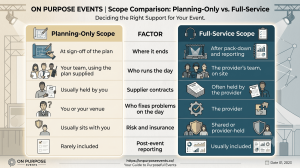
Neither column is better across the board. Planning-only coverage is enough when you have someone internally to run the day. Full-service event planning and management earns its cost when nobody on your team is free to manage suppliers while the event is live.
Questions to Ask When Comparing Scopes
One provider may call itself an event planning company and another an event management company, yet quote for very different work at the same price. These questions surface the gaps before you sign.
Scope and responsibility
- What is explicitly excluded from this quote?
- At what point does your responsibility end and ours begin?
- Who is accountable if a supplier fails to deliver on the day?
Delivery team
- Will the person who wrote this proposal be on site?
- How many staff are included, and for which hours?
- Who is the single point of contact during the event?
Experience
- Which events of a similar size and format have you delivered?
- Can we speak to a client from a comparable event?
- Is production delivered in-house or subcontracted?
Scope also varies by event type. Conferences and staff functions carry different requirements to product launches or incentive programmes. Providers offering meetings and conference planning as a standalone service usually sit closest to this corporate side of the role.
Commercial terms
- Is the fee fixed, or does it move with delegate numbers?
- Are supplier commissions or rebates disclosed?
- What are the cancellation and postponement terms?
Ask for the answers in writing. Coverage agreed verbally is the most common source of dispute after an event.
Final Thoughts
Compare scope, not titles. Work out how far you need support to extend, who runs the day, who holds the supplier contracts, and who carries the risk. Then get the answers in writing before signing anything.
If you are still unsure, ask one question: do you need a plan handed over, or someone accountable on the day? That answer decides the level of support you need, whatever a provider calls it.
On Purpose Events covers the full range of support described here. Our Sydney-based team plans and delivers corporate conferences, product launches and incentive travel, and our senior planners stay on through to the event itself rather than handing off to a separate delivery team.
That suits organisations that would rather not manage two contracts and two points of contact for one event. If you are weighing us against others, ask each provider how far their support extends, since coverage varies widely.
Whichever way you go, get the scope in writing before signing. Event planning vs event management stops being a confusing comparison once that conversation happens, and we are happy to talk it through with you before you commit to anything.