


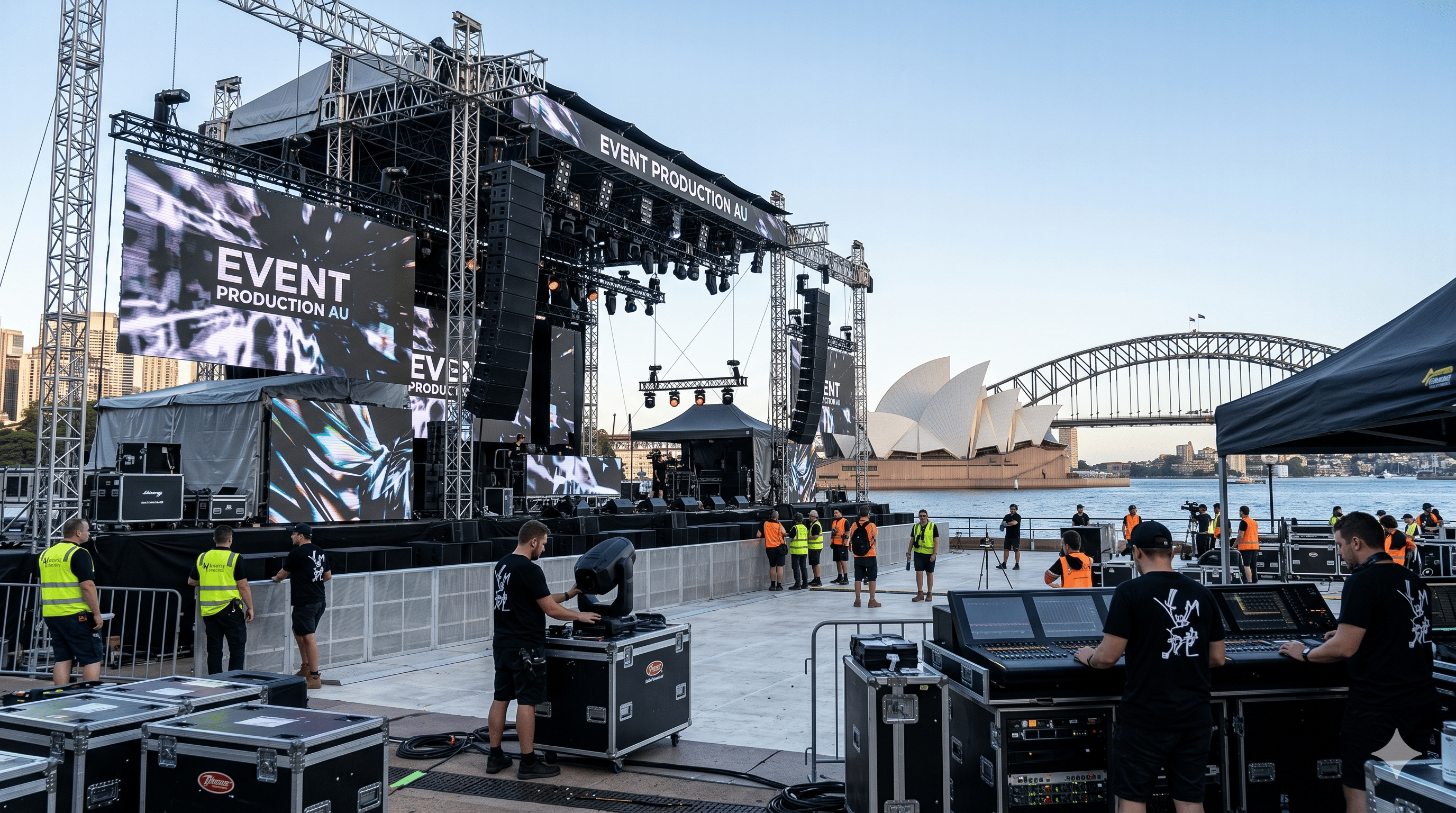
Event Production in Australia: A Practical Guide for Corporate Teams
Event production is the discipline most corporate marketing teams underestimate, and the one that most often determines whether a stakeholder walks out of the room impressed or confused. It sits behind the stage, in the AV booth, and in the pre-show rehearsals. When it’s done well, nobody notices. When it’s done badly, it’s the only thing anyone remembers.
This guide is written for corporate marketing teams, internal event leads, and field marketers who commission event production as part of a broader program. It covers what event production actually is, how the market is structured in Australia, and the practical decisions that separate a show that lands from one that doesn’t.
What event production actually covers
Event production is often confused with event management. They’re different disciplines, usually delivered by different people, sometimes by different companies entirely.
Event management handles the logistics – venue, delegate registration, travel, accommodation, supplier coordination, and the overall program. Event production handles what happens on stage. The two need to work together, but they’re distinct bodies of work.
A complete event production scope typically includes:
Stage design and set build. The physical environment the audience sees, from a simple branded backdrop through to a full scenic build. This is where production budgets often land first, and where they can run away fastest if the brief isn’t tight.
Audio-visual production. Sound, lighting, video, and screens. The technical infrastructure that carries the content to the audience. This is the most technical part of the production, and the area where cutting corners is most visible.
Content and video production. Pre-recorded video packages, speaker reel edits, title cards, and animated graphics. The visual content that moves around the stage.
Show direction and show-calling. The person calling cues from the production desk during the event, coordinating lighting changes, video playback, speaker transitions, and timing. Underrated. Makes or breaks the flow of the show.
Rehearsals and technical run-throughs. The invisible work that makes the visible work look easy. Senior speakers rehearse with production teams so the event feels considered, not under-prepared.
The Australian event production market
The Australian corporate event production market is concentrated around Sydney, Melbourne, and Brisbane, with smaller specialist operators in Perth, Adelaide, and Canberra. Most event production companies Sydney-based work nationally through touring crews and equipment hire relationships.
The market generally falls into three categories:
Full-service production houses. Companies that own their own equipment, employ technical crew, and deliver end-to-end production for corporate events, brand experiences, and conferences. Best for larger events where consistency of delivery matters.
Technical rental and crew specialists. Companies that specialise in AV hire, lighting, and technical crew, often working alongside a broader event agency. Good for programs where the creative direction is already set and the production need is specific.
Content and creative production studios. Focused on pre-produced video content, animation, and scenic design. Often partner with a technical production house for live delivery.
Your corporate event production partner may be one of these, or it may be an event management agency that handles production in-house or through dedicated partners. The question isn’t which model is best. It’s which model fits your brief and your budget.
The Australian Entertainment Industry Association and Event Suppliers and Services Association Australia (ESSA) are useful reference points when evaluating event production suppliers for accreditation and safety standards.
What corporate teams usually get wrong about event production
Three recurring patterns cost corporate teams more than they realise.
Briefing the production team too late. Event production requires lead time. For a significant show, the production company needs to be involved from the moment the venue is confirmed, not six weeks before the event. Late engagement reduces creative options and inflates costs.
Confusing production value with production budget. A high-end show can be delivered on a modest budget if the creative is considered and the production team is given time to design around constraints. A low-end show can still cost a lot if the brief demands scale without focus. What matters is alignment between the ambition and the resources.
Undervaluing rehearsals. Corporate events with senior speakers, complex AV, or live interaction need proper rehearsal time. Most events don’t get it. The difference between a rehearsed show and an under-rehearsed show is visible to every delegate in the room, even if they can’t articulate why.
Event technology and the content experience
Event technology has moved faster than most corporate teams’ briefs have kept up with. Live streaming, delegate engagement platforms, real-time polling, hybrid participation, and live captioning are now baseline expectations, not premium features.
A credible event production partner will be able to discuss:
- Streaming infrastructure and platform selection for hybrid audiences
- Delegate engagement tools that feed content back into the live show
- Captioning and accessibility standards
- Recording, editing, and post-event content distribution
- Data capture and reporting from digital production tools
Ask to see recent examples of events they’ve produced with a significant hybrid or digital component. This is one of the clearest indicators of whether a production company has kept pace with what corporate audiences expect in 2026.
Sustainability in event production
Event production has historically been a significant contributor to the carbon footprint of corporate events. Scenic builds, trucking, power draw from staging and AV, and waste from single-use materials all add up.
Production companies who take sustainability seriously will:
- Use LED lighting and energy-efficient AV equipment as standard
- Design reusable scenic elements rather than single-use builds
- Consolidate trucking and logistics to reduce transport emissions
- Recycle or repurpose scenic materials after the event
- Measure and report the carbon footprint of the production scope
The Climate Active framework can be used by corporate teams to report on event emissions, and your production partner should be able to support that reporting.
How to brief an event production company
A considered production brief covers:
- Event format, venue, and attendee numbers
- The commercial and experiential objectives
- The content structure – what’s happening on stage and in what sequence
- The speakers and their requirements
- Any pre-produced content or existing brand assets
- Your budget range
- Sustainability or reporting requirements
- The delivery timeline
Briefs that focus only on equipment and scope produce transactional quotes. Briefs that include the commercial and experiential context produce proposals that help you evaluate how each production company thinks about the show, not just how they’ll execute it.
Cost structure and what to watch for
Corporate event production costs in Australia vary significantly. A modest half-day conference for 150 people might land anywhere between $15,000 and $50,000 in production costs, depending on the scenic build, AV specification, and content production scope. A major brand event with full staging, hybrid delivery, and pre-produced content can run well above that.
A transparent production quote should itemise:
- Equipment hire (AV, lighting, staging)
- Labour and crew
- Design and creative fees
- Content production
- Freight and logistics
- Rehearsals and pre-production days
- Contingency
Quotes that bundle everything into a single headline number make it difficult to compare across suppliers or to flex the brief if priorities shift.
Timing your production planning
For major corporate events with significant production scope, engage your production partner 6 to 9 months out. For mid-sized conferences and brand events, 3 to 6 months is usually workable. Tight timelines are possible but reduce the creative flexibility and increase the risk of rushed delivery.
Next steps
Define the experiential ambition of your event before you approach production companies. Brief three to four partners consistently. Compare on creative thinking and delivery track record, not just equipment lists.
On Purpose Events delivers end-to-end event production for corporate clients across Australia and Asia-Pacific, working with trusted production partners and established crew networks. Explore our event management services, review our case studies, or get in touch to discuss your production brief.